
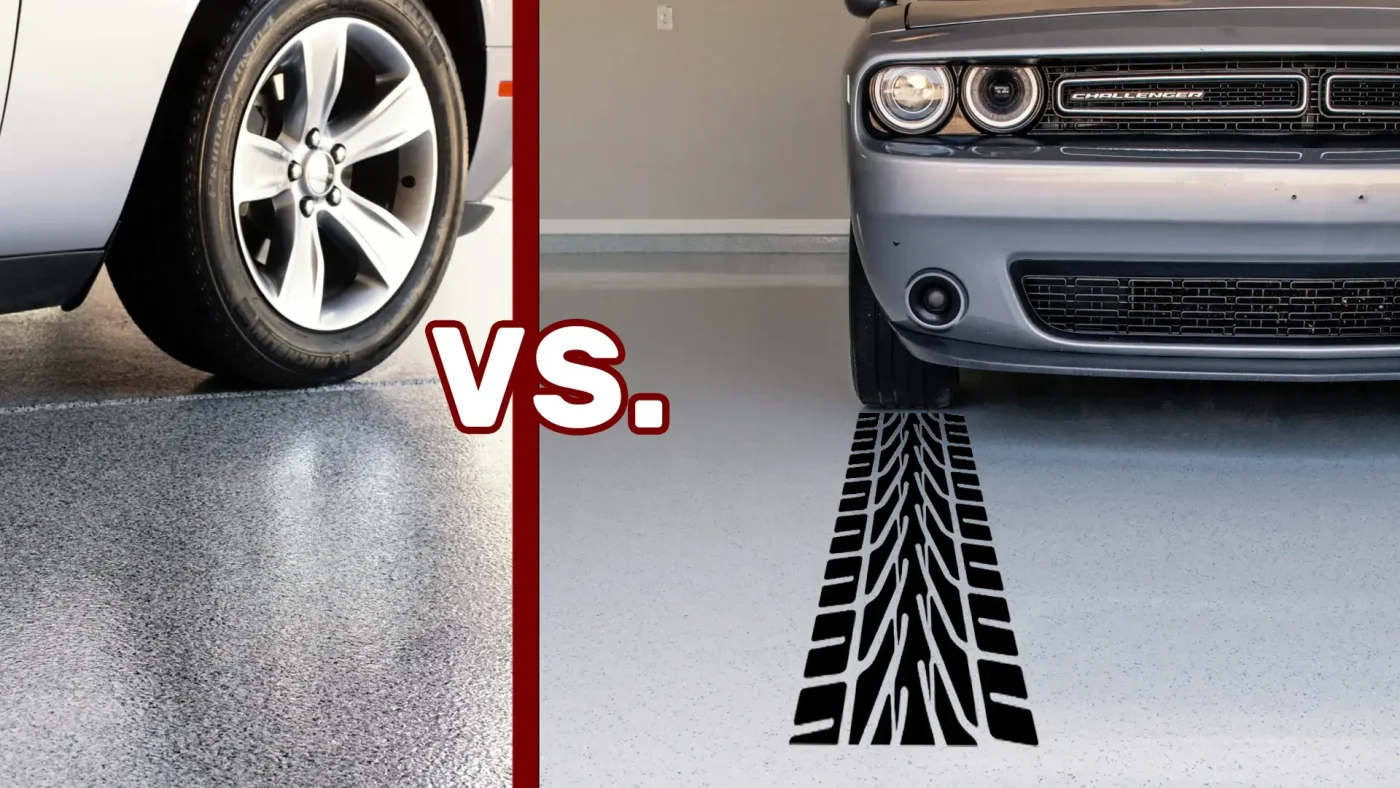
Hot tire transfer is one of the leading causes of early garage floor coating failure. Many homeowners assume their new floor will hold up to daily use, until they start seeing dark marks or surface wear where their car sits. The reality is, not all polyaspartic floor coatings are designed to handle it.
Myth: Hot Tire Transfer Is Just a Surface Issue
It is more than just a visual problem.
Try this. Feel your tires before you drive. Then check them again after even a short trip. Friction with the road heats the rubber quickly.
Car tires contain plasticizers that keep them flexible. As tires heat up, these softening agents migrate to the tire’s surface. Once parked, the plasticizers can transfer from the tires into the concrete coating below, leading to discoloration, tackiness, or even coating failure.
Myth: Any Polyaspartic Floor Coating Can Handle Hot Tires
“1-day” coating systems commonly use lower-quality polyurea or polyaspartic coatings (e.g., 1:1 mix ratio, associated with lower density cross-linking, and less-than-100%-solids). In “1-day” systems, polyurea-polyaspartics are employed as both the: (a) direct-to-concrete primer coat, and the (b) single, clear top coat.
We’ve spoken at length in prior posts about how using a polyurea-polyaspartic as the direct-to-concrete primer coat is a recipe for disaster, given these coating types are quite poor as moisture vapor barriers. However, even when used as intended, as color coats or clear top coats, polyurea-polyaspartics can be problematic when it comes to hot tire transfer. Quality polyaspartics keep hot tire transfer at bay; lesser quality coatings, not so much!
How do you know if the installer is using a quality polyaspartic as the clear top coat? Simple. Read their warranty exclusions. If hot tire transfer (aka plasticizer migration) is not warranted…or if the use of vehicle pads is suggested…get another contractor.
Reality: A 2-Day Polyaspartic Floor Coating System Is Built Differently
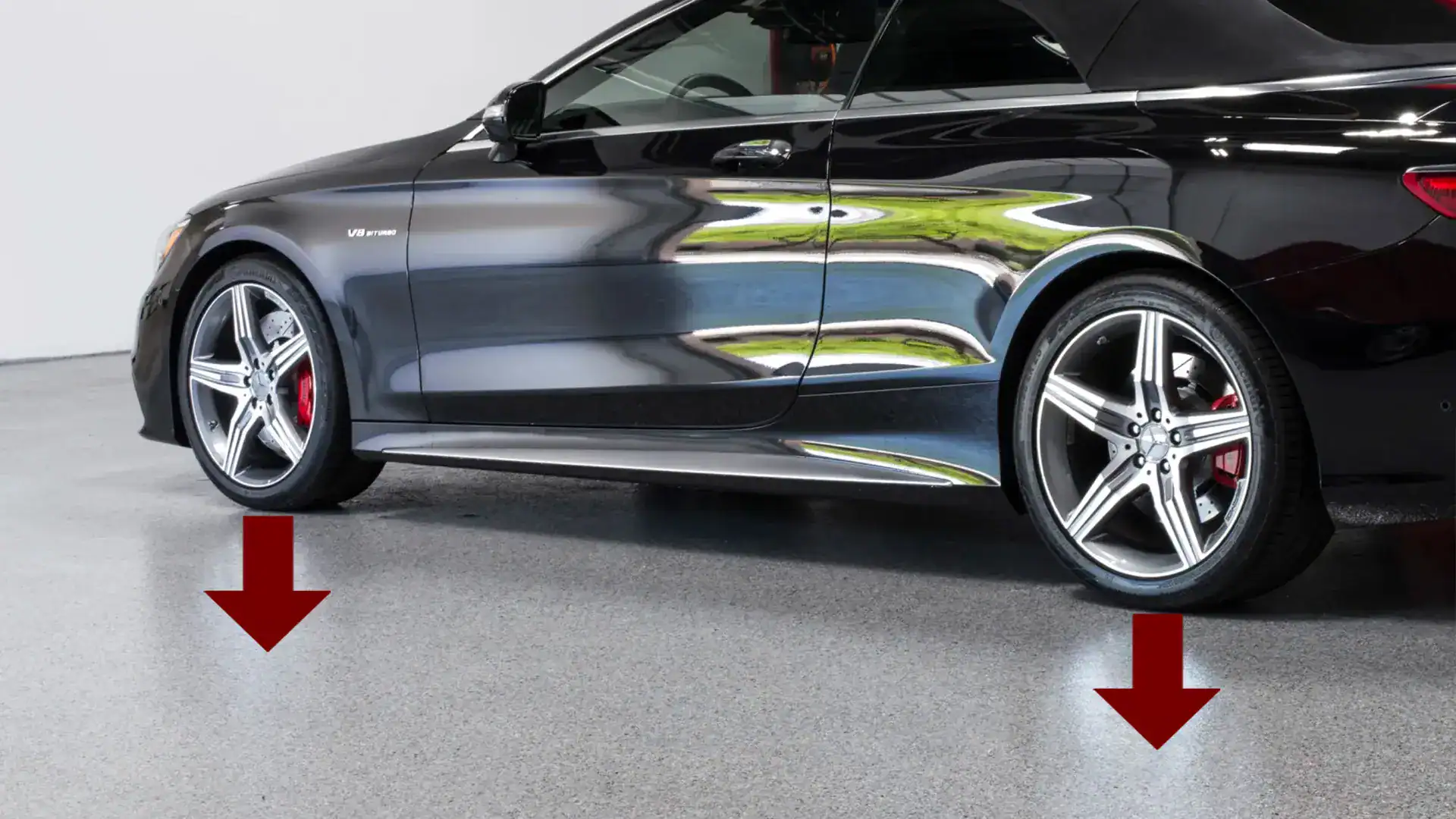
At Garage Floor Coating of Atlanta, we install hybrid epoxy and polyaspartic coating systems, a 2-day process, because long-term durability requires the use of proper quality products, properly layered. We provide quality over speed (not the opposite).
Day one begins with mechanical grinding (using diamond grinders) to prepare the concrete. Then, a slower-curing, moisture-mitigating, 100%-solids epoxy base coat is applied as a moisture vapor barrier (absent in “1-day” coatings). The customer-chosen flake blend is then broadcast into this base layer in a full flake spread, providing added strength and visual appeal. This base is allowed to cure overnight for deep concrete penetration.
On day two, we apply (not one) but two separate high cross-linking, 100%-solids polyaspartic topcoats to create a tough, UV-stable surface that resists heat, pressure, chemical exposure…and yes, hot tire transfer.
Reality: The Right Coating Stops Hot Tire Transfer
A properly installed polyaspartic floor coating prevents hot tire pickup, resists staining, and maintains its appearance over time.
In Atlanta’s heat and humidity, that level of protection is essential.
Contact Garage Floor Coating of Atlanta today to learn more about a polyaspartic floor coating system that prevents hot tire transfer from the start.
About the Author

Share this Post